
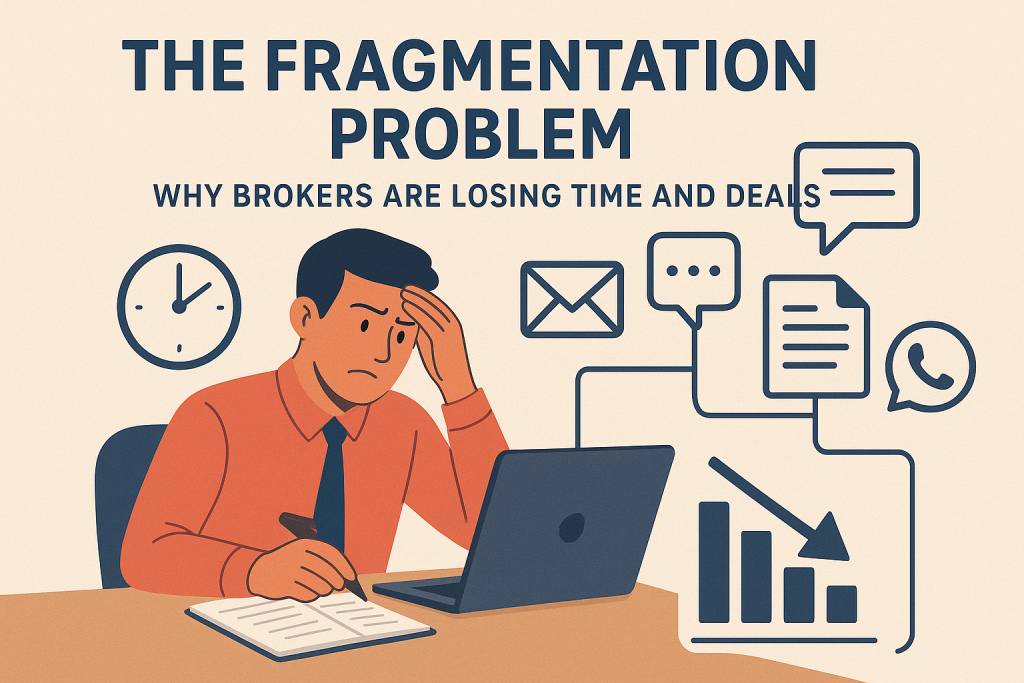
London’s commercial property market has never moved this fast. Deals that once crawled along over months now unfold in a matter of weeks. Brokers field enquiries from every direction email, WhatsApp, portals, in-person introductions and try to keep all of it organised while maintaining relationships and pushing deals onward.
What’s become obvious across the industry is this: most brokers aren’t running out of opportunities; they’re running out of capacity.
Instead of spending their day negotiating, advising, and closing, many find themselves buried in admin chasing information, updating systems, preparing documents, and trying to stitch together data scattered across different tools. It’s not unusual for teams to realise that the majority of their week is spent on work that doesn’t directly generate revenue.
Too Many Tools, Too Little Alignment
Walk into almost any brokerage team today and you’ll see the same pattern:
a CRM that holds some information, a spreadsheet used for something the CRM should do, a proposal builder, an email marketing platform, WhatsApp threads full of critical details, and a series of shared folders that no one has time to maintain.
Individually, each tool is fine. Together, they create friction.
Information gets duplicated. Data becomes inconsistent. Tracking a client’s history turns into detective work. And when brokers need something quickly a latest enquiry, a proposal version, a follow-up status they often have to search across multiple systems just to piece the story together.
Every extra tool adds another point where information can be missed, delayed, or forgotten.
How Fragmented Workflows Slow Down Deals
When a new enquiry comes in, brokers rarely have one clean path to follow. Instead, the typical process looks like this:
- A client message arrives through WhatsApp or email.
- The broker makes a mental note to log it later.
- Proposal documents are rebuilt from older templates because nothing is centralised.
- Email sequences or follow-ups sit in a different tool that doesn’t sync with the CRM.
- Deal progress is updated inconsistently or only at the end of the week.
- Reporting requires manual digging through multiple records.
None of these steps seem catastrophic on their own. But together, they create enough drag to slow deal momentum and in a competitive market, hesitation is expensive.
Teams relying heavily on manual updates and unconnected tools often realise too late that leads have slipped through cracks or prospects have moved on because the response time was too slow.
The Hidden Cost: Lost Opportunities, Not Lost Hours
The real damage of fragmentation isn’t just inefficiency.
- It’s the deals that don’t advance.
- It’s the prospects that quietly disengage.
- It’s the time spent finding information instead of building relationships.
When brokers operate without a unified system:
- Leads get forgotten inside inboxes or chat threads.
- Work is duplicated because teams recreate documents instead of drawing from a shared source.
- Response times stretch, giving competitors a chance to jump in.
- Teams lose visibility, making it harder to anticipate a client’s next move or understand where deals truly stand.
- Morale drops, as brokers feel like administrators rather than advisors.
What looks like a “productivity problem” is actually a pipeline-leak problem.
A Market Moving Toward Integration
Across the property sector, firms are recognising that fragmented workflows can’t support modern deal cycles. Investment in automation, AI-enhanced CRMs, and unified platforms is rising not because technology is trendy, but because the alternative is falling behind.
A single, connected system gives brokers what they lack today: a clean picture of every client, one source for all deal data, and the ability to move from enquiry to closing without switching between half a dozen tools.
The brokerages embracing integrated workflows are already seeing faster turnaround times, clearer communication, and fewer lost opportunities. Meanwhile, those clinging to manual processes are struggling to maintain pace in a market where speed directly influences outcomes.
The Real Question for Brokers Today
The discussion is no longer about whether technology matters. It’s about whether fragmented workflows are costing more than they seem. A unified approach doesn’t just save time it strengthens deal execution, reduces risk, and helps brokers focus on the part of the job that actually moves revenue: building relationships and closing transactions.
In a market defined by speed and precision, the teams that eliminate fragmentation will gain a decisive edge over those still trying to piece together their workflow one tool at a time.